
Autonomous Decentralized AI Cell & Hashchain Are the Core Technology of the Physical AI Era.
Sees Co., Ltd.
Sees Co., Ltd.
-
Back
Physical AI
Ahead of the rise of physical AI, we developed our proprietary "Autonomous distributed AI" technology.-
 Autonomous Distributed AI Cell
Proprietary technology chip realizing the ultimate Physical AI by operationalizing the Child AI concept and integrating it with Hashchain.Facial Recognition/Recognition AI Blockchain Surveillance Camera
Ultimate AI Blockchain surveillance camera integrating facial recognition AI into a Blockchain chip.AI Poisoning Prevention System
System completely preventing Data Poisoning vulnerabilities in AI equipped with an AI Front-End Engine.Data Security
We provide end-to-end data security from sensors to the cloud.-
Scramble Memory
Ultimate data recording method realizing the Zero Trust concept that remains unreadable even if stolen. -
Hashchain
Hashchain is the ultimate innovative technology in data security providing seamless end to end data protection from sensors to the cloud. -
Sees Blockchain
Blockchain optimized for industrial use realizing simultaneous operation of multiple applications through parallel processing. -
Sees Blockchain Security System
Security system linking blockchain products that satisfy four information security requirements of leakage prevention tampering prevention stable operation and user authentication. -
Blockchain Chip
Revolutionary technology in IoT control data security shrinking embedded blockchain into a single chip. -
Mobile Blockchain Nodes
Converts mobile devices into blockchain nodes and protects transmitted and received data through a blockchain network. -
Blockchain Transformers
Blockchain dongle that builds a blockchain node simply by connecting to a USB port. -
Blockchain Gateway
Builds a blockchain environment via LAN connection and protects transmitted and received data with robust security. -
Blockchain Server
Server preinstalled with industrial blockchain enabling immediate blockchain node setup upon installation.
DApps (Decentralized Applications)
DApps (decentralized applications) that utilize our proprietary "Continable NFT" technology.-
Consensus Lock
Shares consensus and conclusion among all meeting participants to prevent unnecessary trouble in advance. -
Beneficial Avatar
Clone trained on your own thinking and knowledge working on your behalf twenty four hours a day. -
NFT-based reservation rights issuance and trading system
Reservation right NFT issuance system realizing automated fair trade in bookings. -
Pre-packaged Blockchain
Builds and operates blockchain applications answering any needs for customization costs alone.
Development and Implementation Support
Whether it’s IT development or digital transformation (DX) implementation, feel free to consult us about anything related to IT.-
Sees Blockchain Development SDK
Software development kit with technical support that enables building blockchain applications without prior blockchain technology expertise. -
Blockchain custom-made development
Builds original blockchain within a low budget and short period while integrating with existing applications. -
Support for blockchain implementation
Total support service for blockchain digital transformation. -
Blockchain Learning Tool "Hakoniwa System"
World only blockchain learning tool for learning smart contracts while operating blockchain in a closed environment. -
 Sees Blockchain Linux
Linux optimized for blockchain to operate blockchain at high speed and with stability.
-


-
Back
Essence
A white paper-style story detailing Sees technology and history-
Autonomous Decentralized AI Cell Story
The core technology that logicized the concept of "Child AI" that autonomously learns, which is essential in the era of physical AI. -
Scramble Memory Story
The ultimate data security recording technology that achieves Zero Trust, born from the concept of protecting the data itself rather than the storage medium. -
Sees Hashchain Story
The origin story of Hashchain which represents the culmination of highly reliable technology in data transmission. -
Sees Blockchain Introduction
The story of blockchain from its dawn to the birth of Sees Blockchain. -
Sees Future Prospects
We will create the next generation of IT culture in the Physical AI and data security fields by bringing together technological capabilities cultivated in cutting edge infrastructure domains.
-

The Secret Story Behind the Birth of "Autonomous Distributed AI Cell"
The "Autonomous Distributed AI Cell" Concept in the Physical AI Era
Now that we have entered the heyday of physical AI, a system in which AI directly operates and educates physical AI is strongly required for the purpose of eliminating human error and information leakage.
However, conventional methods equipping completed AI given huge amounts of training data and simulation results cannot cope with physical noise and individual differences on site, making individual tuning for each installation the biggest bottleneck.
The "Autonomous Distributed AI Cell" created by our company is a technology that fundamentally transforms this structural issue.
"Autonomous Distributed AI Cell" logicized the process itself where a newborn child learns by itself through the five senses such as vision and touch, logicizing the concept of so-called "Child AI".
Our company predicts the arrival of an era in which these small "cell computers (Child AI)" learn and act autonomously, rather than building centralized AI with huge computers.
And multiple cell computers deployed around the world share and complement each other's learning information, and when this is realized, a super AI will be born that far surpasses AI built with a single huge computer, looking over the whole world with a bird's eye view and an insect's eye view, and also equipped with detailed physical parts.
Each cell computer can be compared to a single brain cell or nerve cell, and as the number increases, intelligence and processing power increase.
The result of aiming for such a world like a science fiction movie is the cell computing patented technology called "Autonomous Distributed AI Cell", and we are confident that it will become an essential technology in the near future.
Limitations of Virtual Space Simulation and Issues of Federated Learning in the Physical AI Era
Currently, in physical AI domains including robotics and unmanned factories, methods using virtual space simulations represented by NVIDIA Isaac Sim and others to quickly train AI and port it to reality are becoming mainstream.
However, no matter how many hundreds of millions of times simulation is repeated in virtual space, an absolute physical gap exists between it and the real world, and it cannot perfectly master unpredictable events such as wear after operating for 1,000 hours or site-specific noise.
In addition, federated learning that brings together learning results from multiple devices is also being researched in the AI industry.
However, conventional general federated learning averages data at the center, having the issue of erasing physical individual differences for each device.
"Autonomous Distributed AI Cell" can achieve overall evolution while retaining individuality by separately managing differences in unique information and shared information.
Furthermore, in the conventional structure of sending all sensor data to the cloud and having large-scale models make decisions, as the number of sensors increases, risks due to communication delays and processing overloads follow.
What is truly required in the physical AI era is technology that autonomously absorbs noise and individual differences in real time on the site device (edge) side.
To address this issue, our company created a patented technology that balances "group education" mutually enhancing each other while maintaining the individuality of each site device, and ultra-low latency autonomous control in local environments.
Logics of the "Child AI" Concept in "Autonomous Distributed AI Cell"
There are seven main logics in "Autonomous Distributed AI Cell" to achieve complete autonomy on site.
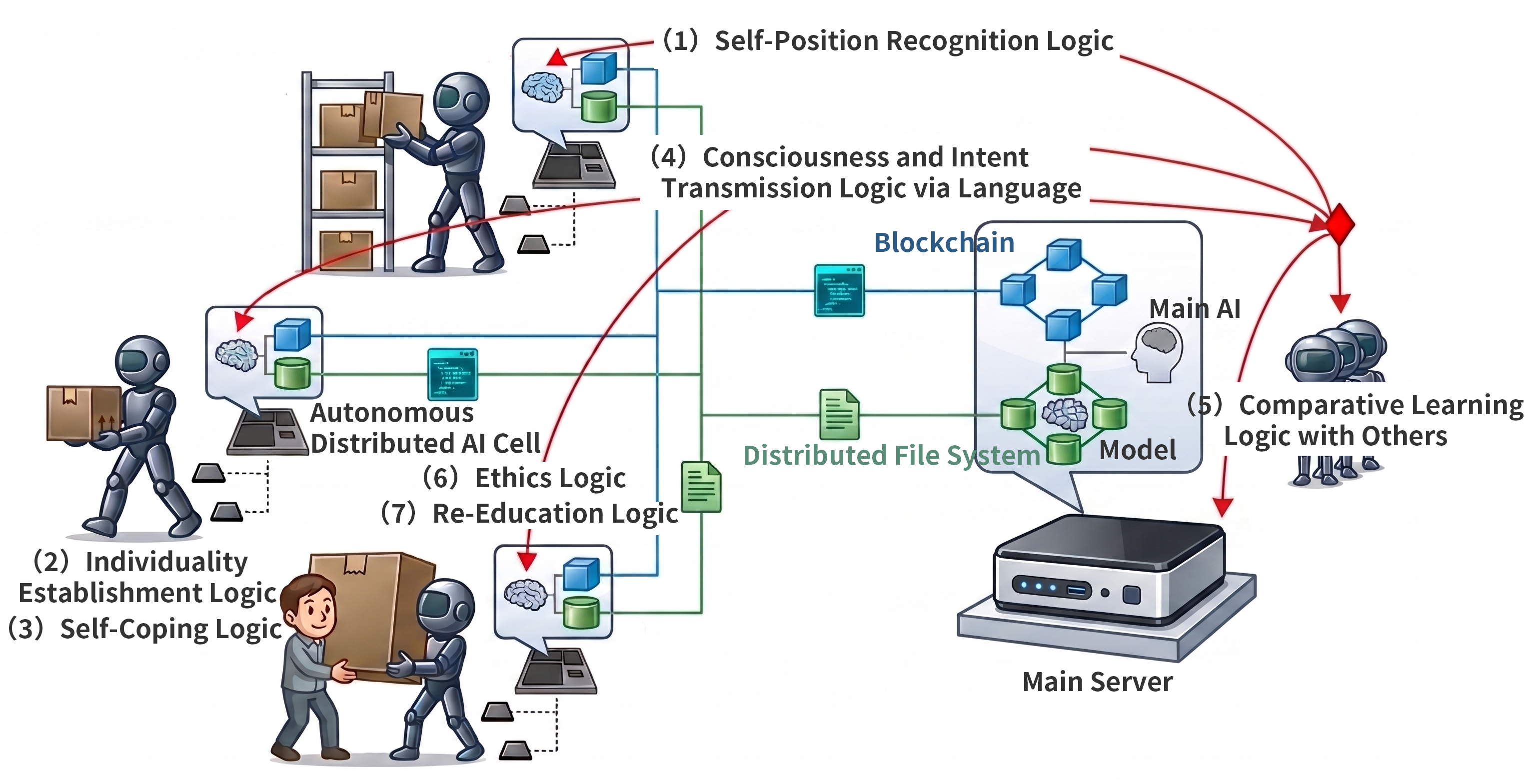
(1)Self-Position Recognition Logic (Awareness of Where One Is and What One Should Do)
It analyzes data from sensors and autonomously grasps what it is installed on, its exact location, and the equipment to be controlled through information sharing with other "Autonomous Distributed AI Cells" via upper servers.
This individuality information is not only notified to upper servers, but is also utilized by itself for real-time control.
(2)Individuality Establishment Logic (Autonomously Recognizing Individual Quirks)
It measures individual differences due to slight manufacturing deviations or aging degradation from sensors in real time, and autonomously masters limit values such as "how far is safe and from where is abnormal for this machine", which is the establishment of identity.
(3)Self-Coping Logic (Acting on the Spot Without Waiting for Instructions from Main AI in Emergencies)
In millisecond-unit emergency situations where waiting for instructions from the main AI will not be in time, it acts immediately on its own judgment.
The moment it senses danger, the chip on site directly executes safety controls such as emergency stops by itself.
(4)Consciousness and Intent Transmission Logic via Language (Conveying Statuses in Words)
It converts physical statuses and nuances on site into "words" that humans and large language models (LLMs) can intuitively understand, and outputs them.
By directly appealing to the "thinking process of capturing context" originally possessed by humans and upper systems (LLMs, etc.), it enables sharing raw sensations on site directly with upper LLMs without intermediate analysis programs, allowing advanced and flexible automatic decisions, and it also enables linking with generative AI.
(5)Comparative Learning Logic with Others (Knowing One's Position Compared to Surroundings)
The upper main AI analyzes operation data and limit values collected from each "Autonomous Distributed AI Cell" all together.
By objectively grasping relative biases and differences with other "Autonomous Distributed AI Cells" from an overall perspective, it autonomously senses and identifies signs of minute anomalies and individual difference shifts that cannot be noticed by a single site unit alone.
(6)Ethics Logic (Correcting Biases in Language Outputs and Judgments from Upper Overall Perspective)
Upper servers or edge servers make total predictions and judgments, and perform education such as correcting language information and parameters output to each "Autonomous Distributed AI Cell".
It is a mechanism to correct judgment biases and over-corrections caused by local optimization of single sites toward global optimization through guidance from above so as to maintain harmony as a whole system.
(7)Re-Education Logic (Automatically Updating to the Latest Status)
In addition to monitoring installation location movements through periodic polling and automatic updates of 3D maps, it continues to import overall knowledge and optimization data obtained through individuality comparative analysis in the background.
Rather than erasing individual differences like overall collective updates in conventional federated learning, it continuously re-educates itself autonomously into the latest operation model fitted to the site environment while maintaining the individuality unique to that device.
Growth Process Through Standard Models and Optimized Models
A single "Autonomous Distributed AI Cell" cannot perform huge calculation or learning processing, so by adopting a two-layer structure that receives base models (standard models) generated by prior simulations or past learning shared from knowledge bases, and corrects them into optimized models via local adjustment logics, it achieves immediate site adaptation while minimizing site loads.
(1)Role Recognition Through Sensor Data and 3D Maps
It collates current positions autonomously acquired from various sensors connected to the main body with 3D map information downloaded from upper servers.
Then, by multiplying data sent from connected sensors, it autonomously identifies in which location, on which device, and at which sensor it is placed, and determines the standard model to apply.
(2)Sharing Standard Models and Inheriting Knowledge of Predecessors
Upper servers retain models generated in simulations and operation models accumulated at other sites.
At installation, it acquires the corresponding initial model, and if a predecessor "Autonomous Distributed AI Cell" existed in the same position, it directly inherits and acquires the optimized model learned on site by the predecessor.
Through this, operation can be started without interrupting past operational knowledge.
(3)Optimized Model (Local Adjustment of Hardware Individual Differences)
Based on the received standard model, it performs real-time corrections locally while operating against hardware-specific physical individual differences such as optimal rotation speeds for each motor or wear tolerances of parts, fitting immediately into optimized models without straining resources.
(4)Re-Education by Main AI and Distribution of Model Updates
Full-scale re-education processing performed based on operation data collected from sites and models optimized by each cell is executed all together in the background on the upper main AI side having sufficient computational capability.
Because the edge side receives the latest education data re-educated and updated on the main AI side, various education data continues to be updated safely at all times.
(5)Backup and Immediate Restoration of Individual Setting Data
Readjustment on site is unnecessary even during failures, because correction parameters adjusted to site individual differences are constantly recorded as numerical data, so when replacing devices or sensors, it recovers immediately simply by writing back this numerical data and re-correcting minute shifts in hardware individual differences in a short time.
Revolution Brought by "Group Education"
Connected through networks, individual "Autonomous Distributed AI Cells" that have constructed optimized models on site enable the "group education" mechanism that maximizes the adaptability of the entire system to function.
This refers to the point where danger information, obstacle avoidance approaches, and other insights acquired by one "Autonomous Distributed AI Cell" can be shared across all "Autonomous Distributed AI Cells".
Unlike general federated learning that averages all data and distributes a uniform model, group education by "Autonomous Distributed AI Cell" selectively imports and applies corrections only to necessary information and parameters shared from others while retaining physical individuality possessed by each individual.
Through this, individual adaptation to site environments and immediate responsiveness of the entire system where the experience of one unit immediately propagates to the whole are balanced.
Supporting this advanced group education are proprietary "Child AI" logics and transmission data security technologies closely linked together.
First, physical phenomena and risk information on site are immediately converted into meaningful text such as "the right joint is overheating" by the intent transmission logic.
Through this, humans and large language models (LLMs) can correctly understand site situations without going through advanced specialized programs.
Next, "Self-Position Recognition", "Self-Coping Logic", and "Ethics Logic" link together, comprehensively grasping situations and positional relationships of one's own device and other devices.
It implements cooperative control considering overall optimization at the site level so that arbitrary avoidance actions by a single device do not cause confusion across the entire line.
Even in emergency situations where communication is severed, safety control is completed through cooperation between "Autonomous Distributed AI Cells".
Information and know-how stored and shared in "Autonomous Distributed AI Cells" are protected end-to-end by data security technologies implementing "Scramble Memory", which cannot be viewed by anyone other than the authorized person even if recorded data is taken, as edge recording technology, and adopting "Hashchain", which guarantees legitimacy in segment units of transmitted data, as communication technology.
It reliably blocks system contamination due to third-party tampering, hijacking, or data poisoning (mixing abnormal values) in both communication layers and local data storage areas.
Because it links with upper large language models (LLMs) and other systems under high unalterable reliability, a safe and sustainable cycle of group education is established.
*"Scramble Memory" and "Hashchain" are patented technologies of Sees Co., Ltd.
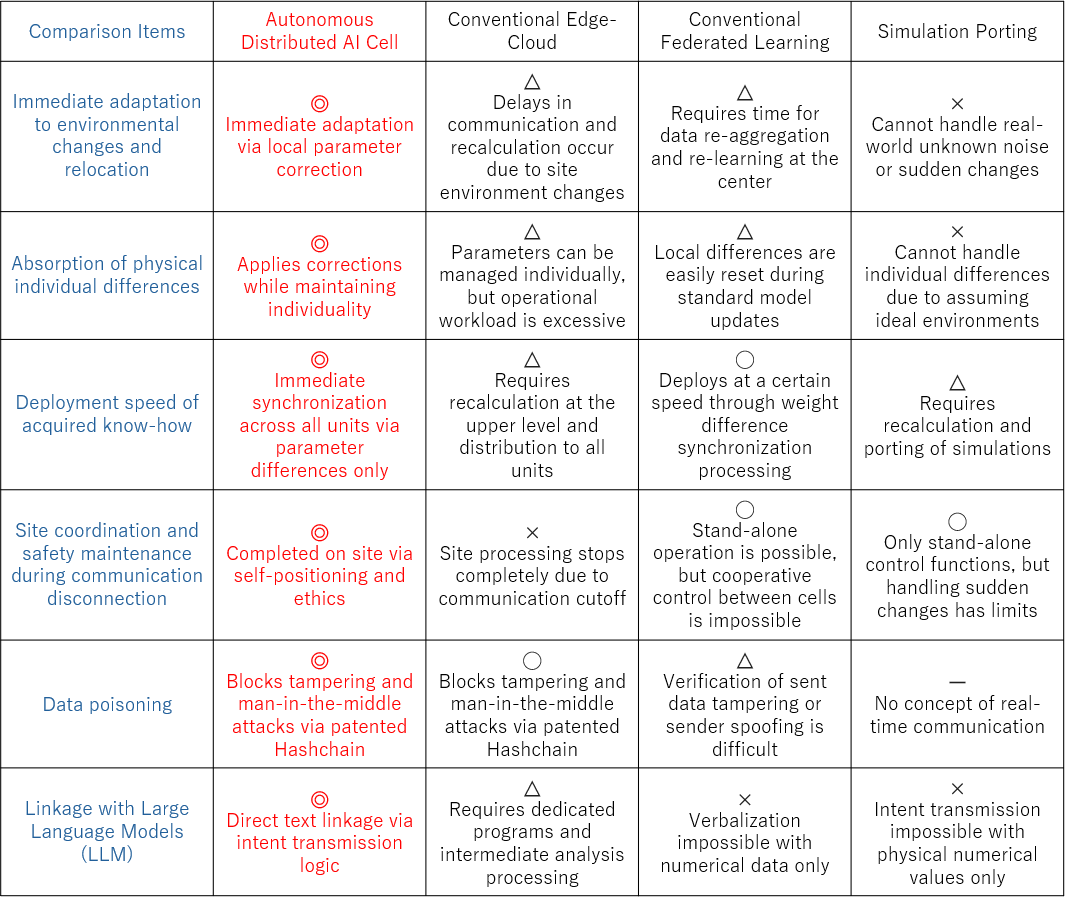
Comparison in the Physical AI Domain
"Autonomous Distributed AI Cell" fundamentally resolves structural issues held by conventional control systems and existing AI learning methods.
Specific Use Cases of "Autonomous Distributed AI Cell"
"Autonomous Distributed AI Cell" highly balances elements such as "site adaptation", "safety sharing", and "tampering prevention" that were difficult with conventional control methods, creating use cases at various sites.
(1)Group Education and Optimization via Edge Servers (Site Adaptation to Factory Individual Differences)
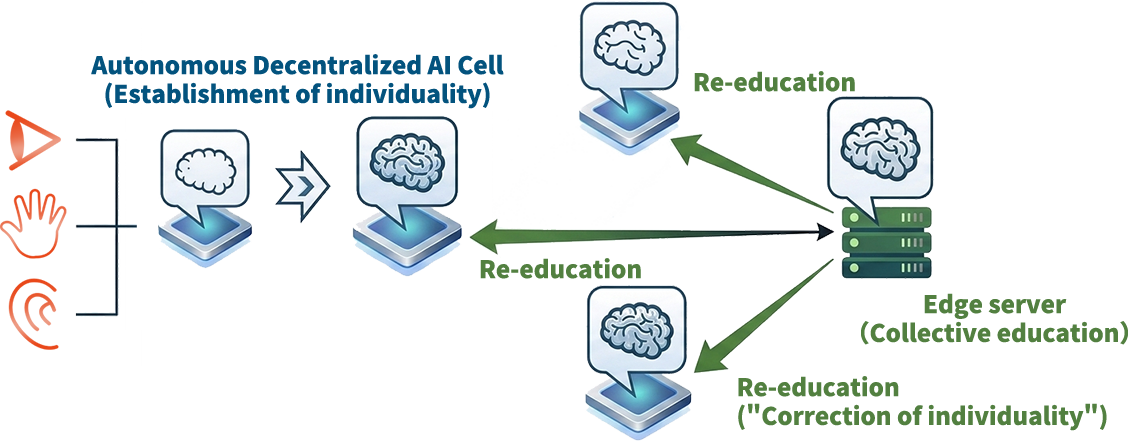
Each device installed in a factory autonomously learns site environments and operations through sensors, carrying out "establishment of individuality".
Because individual differences occur even in the same devices, it acquires operation data of each individually to achieve optimization for the site.
Sensor data collected from individual devices is comparatively analyzed on upper edge servers, executing "correction of individuality" that automatically adjusts voltages and control parameters so that all devices can produce uniform output.
By "re-educating" the entire experience of each unit while maintaining the individuality of each machine, it prevents quality variation and builds sustainable industrial infrastructure that continues operating with high precision.
(2)Automatic Drone Control (Group Flight Control via Master/Slave)
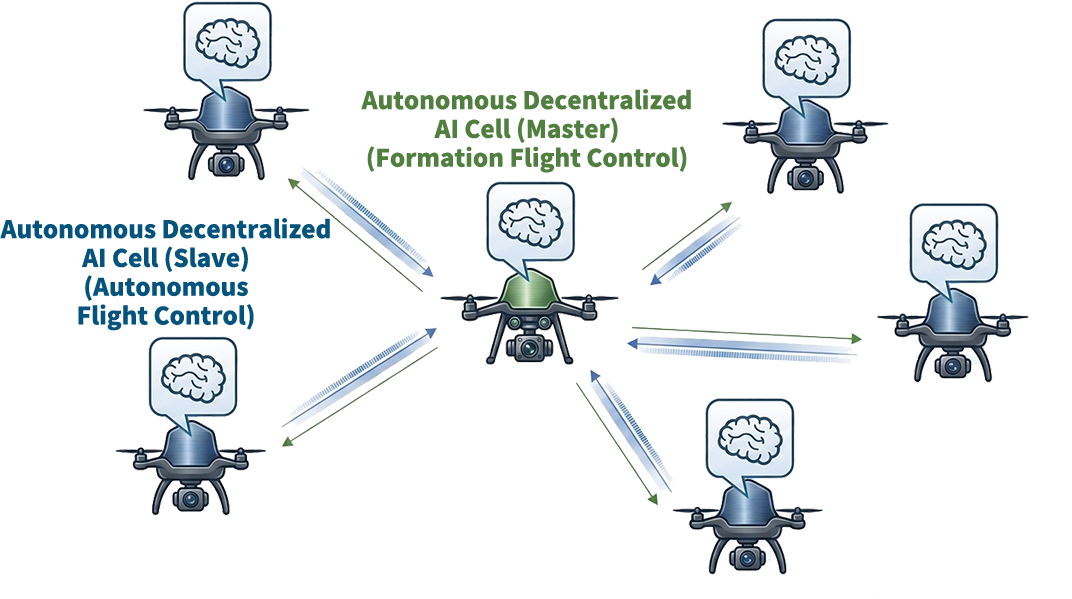
Under group flight control by a master aircraft, multiple slave aircraft perform autonomously controlled flights while cooperating mutually.
Optimization parameters such as danger information and optimal routes acquired on site by one drone are immediately shared (group education) across the whole through communication and storage paths whose safety is guaranteed by "Hashchain" and "Scramble Memory".
Even if communication delays or disconnections occur, each slave aircraft autonomously completes safe avoidance actions by itself through self-position recognition via sensors.
Furthermore, as the number of operating aircraft increases, it demonstrates an overwhelming network effect where the entire drone swarm automatically becomes smarter, executing advanced group actions while reliably excluding data poisoning.
*"Scramble Memory" and "Hashchain" are patented technologies of Sees Co., Ltd.
(3)Predictive Maintenance System Linked with Blockchain
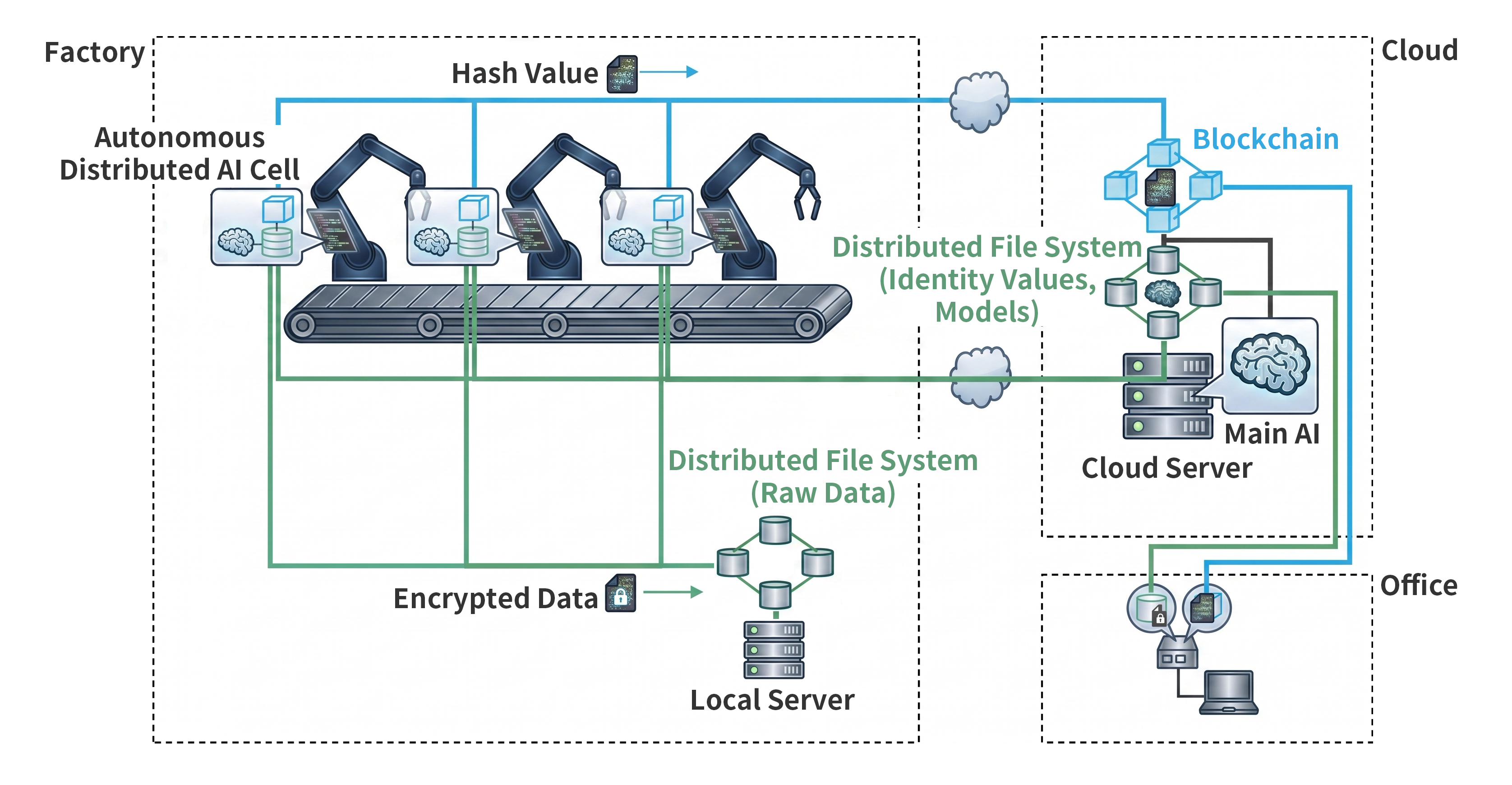
By incorporating "Autonomous Distributed AI Cell" into predictive maintenance systems for production lines or whole factories, it builds individually optimal anomaly detection models corresponding to differences in work contents or wear degrees for each robot arm, achieving high-precision failure prediction.
What is important here is that learning data generated on site is protected and safely shared (re-educated) in two layers of "Scramble Memory" and Blockchain, enabling safe synchronization of only the latest models in a state where risks of tampering, poisoning attacks, or hijacking are reliably excluded.
*"Scramble Memory" is a patented technology of Sees Co., Ltd.
The Future Brought by "Autonomous Distributed AI Cell"
The essence of "Autonomous Distributed AI Cell" lies in core technology that logicized the concept of "Child AI" growing autonomously on site, "group education" mutually enhancing intelligence while retaining individuality, and an autonomous distributed processing structure where they behave like brain cells or nerve cells.
In other words, as the number increases, intelligence and processing speed improve dramatically, making it a technology created based on a thinking on a different dimension from conventional systems.
The moment it is installed, "Autonomous Distributed AI Cell" begins learning as an individual and safely shares information and insights with each other in distributed networks.
What will happen if "Autonomous Distributed AI Cells" are applied to mobility or security cameras and deployed around the world? It will become possible to grasp situations around the world clearly, and if they behave to prioritize interpersonal safety mutually, many human lives can be protected through accident prevention.
With "Autonomous Distributed AI Cell", the world of cell computing that overlooks the whole world in real time and autonomously controls details in depth, which cannot be reached by huge single AIs, becomes a reality.
Sees Co., Ltd. secures intellectual property, fundamentally rewrites concepts of existing IT culture, and pioneers a safe and advanced physical AI society free of human error and information leakage.
Created in August 2026
HISAO ITO, CEO, Sees Co., Ltd.
Back to Top