
Autonomous Decentralized AI Cell & Hashchain Are the Core Technology of the Physical AI Era.
Sees Co., Ltd.
Sees Co., Ltd.
-
Back
Physical AI
Ahead of the rise of physical AI, we developed our proprietary "Autonomous distributed AI" technology.-
 Autonomous Distributed AI Cell
Proprietary technology chip realizing the ultimate Physical AI by operationalizing the Child AI concept and integrating it with Hashchain.Facial Recognition/Recognition AI Blockchain Surveillance Camera
Ultimate AI Blockchain surveillance camera integrating facial recognition AI into a Blockchain chip.AI Poisoning Prevention System
System completely preventing Data Poisoning vulnerabilities in AI equipped with an AI Front-End Engine.Data Security
We provide end-to-end data security from sensors to the cloud.-
Scramble Memory
Ultimate data recording method realizing the Zero Trust concept that remains unreadable even if stolen. -
Hashchain
Hashchain is the ultimate innovative technology in data security providing seamless end to end data protection from sensors to the cloud. -
Sees Blockchain
Blockchain optimized for industrial use realizing simultaneous operation of multiple applications through parallel processing. -
Sees Blockchain Security System
Security system linking blockchain products that satisfy four information security requirements of leakage prevention tampering prevention stable operation and user authentication. -
Blockchain Chip
Revolutionary technology in IoT control data security shrinking embedded blockchain into a single chip. -
Mobile Blockchain Nodes
Converts mobile devices into blockchain nodes and protects transmitted and received data through a blockchain network. -
Blockchain Transformers
Blockchain dongle that builds a blockchain node simply by connecting to a USB port. -
Blockchain Gateway
Builds a blockchain environment via LAN connection and protects transmitted and received data with robust security. -
Blockchain Server
Server preinstalled with industrial blockchain enabling immediate blockchain node setup upon installation.
DApps (Decentralized Applications)
DApps (decentralized applications) that utilize our proprietary "Continable NFT" technology.-
Consensus Lock
Shares consensus and conclusion among all meeting participants to prevent unnecessary trouble in advance. -
Beneficial Avatar
Clone trained on your own thinking and knowledge working on your behalf twenty four hours a day. -
NFT-based reservation rights issuance and trading system
Reservation right NFT issuance system realizing automated fair trade in bookings. -
Pre-packaged Blockchain
Builds and operates blockchain applications answering any needs for customization costs alone.
Development and Implementation Support
Whether it’s IT development or digital transformation (DX) implementation, feel free to consult us about anything related to IT.-
Sees Blockchain Development SDK
Software development kit with technical support that enables building blockchain applications without prior blockchain technology expertise. -
Blockchain custom-made development
Builds original blockchain within a low budget and short period while integrating with existing applications. -
Support for blockchain implementation
Total support service for blockchain digital transformation. -
Blockchain Learning Tool "Hakoniwa System"
World only blockchain learning tool for learning smart contracts while operating blockchain in a closed environment. -
 Sees Blockchain Linux
Linux optimized for blockchain to operate blockchain at high speed and with stability.
-


-
Back
Essence
A white paper-style story detailing Sees technology and history-
Autonomous Decentralized AI Cell Story
The core technology that logicized the concept of "Child AI" that autonomously learns, which is essential in the era of physical AI. -
Scramble Memory Story
The ultimate data security recording technology that achieves Zero Trust, born from the concept of protecting the data itself rather than the storage medium. -
Sees Hashchain Story
The origin story of Hashchain which represents the culmination of highly reliable technology in data transmission. -
Sees Blockchain Introduction
The story of blockchain from its dawn to the birth of Sees Blockchain. -
Sees Future Prospects
We will create the next generation of IT culture in the Physical AI and data security fields by bringing together technological capabilities cultivated in cutting edge infrastructure domains.
-


The Secret Story Behind the Birth of "Scramble Memory"
In today's digital environment, security measures relying solely on network perimeter defense have reached their limits, making the transition to zero-trust security that suspects and verifies every access an urgent priority.
However, storage security technologies such as conventional encrypted drives had a structural weakness where data in storage was released from protection and converted back to plaintext after the system booted and user authentication was completed.
In this way, during system operation, sufficient defense capability cannot be demonstrated against host OS vulnerabilities or unauthorized intrusions.
To address this challenge, Sees Co., Ltd. took on a completely new approach on a different dimension from conventional security, and "Scramble Memory" does not consider security in units of media or files, but is created by considering a method that guarantees the authenticity of continuous data itself so that it cannot be read even if taken.
It is a technology that applies Sees' patented technology called "Hashchain", which realizes high security in data units in data transmission from sensors to the cloud, directly to data recording, and realizing high security in data units is the basic concept of "Scramble Memory".
Existing Data Protection Technologies and Issues
With the spread of zero-trust security that trusts no access and always verifies, we have entered an era where continuous verification is required not only at the entrance of internal and external networks, but also in the protection of stored data itself.
International standard ISO/IEC 27040 regarding storage security also requires comprehensive lifecycle management, going beyond mere data encryption to securing data integrity and authenticity up to safe data destruction.
Overview and Limitations of Data Protection Storage Methods
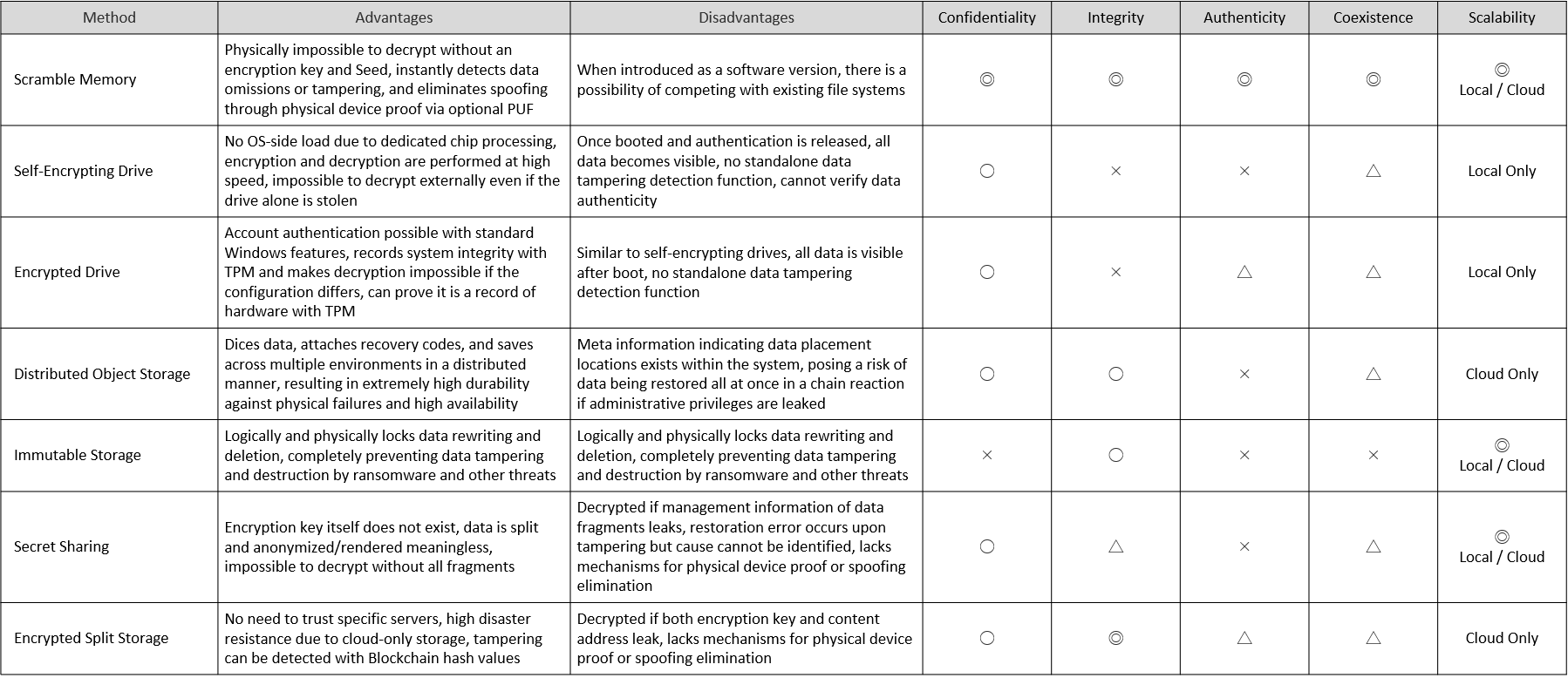
Although major data protection storage technologies currently in operation have evolved specializing in specific threats and usage environments, they each possess inherent structural limitations in comprehensive data preservation required under a zero-trust environment.
(1) Self-Encrypting Drive Method (SED)
It is a hardware encryption technology installed in major SSDs and other devices.
It maintains high confidentiality when the drive alone is stolen, but after the OS boots and authentication is completed, the entire area is released from protection all at once, rendering it powerless against malware or unauthorized intrusion during system operation.
In addition, it does not possess functions to detect data tampering or to prove access authenticity.
(2) Encrypted Drive Method
It is software encryption such as BitLocker that functions at the OS or file system layer.
It performs checks of system integrity using TPM chips, but its structural limitation of not having sufficient defense capability against intrusions during system operation because the entire area is released after OS boot or authentication completion is similar to self-encrypting drives.
(3) Distributed Object Storage Method
It is a cloud technology that divides data into objects, attaches recovery codes, and saves them across multiple environments.
Although fault tolerance is extremely high, because meta information indicating data placement locations exists within the system, it carries the risk of being restored all at once if administrator privileges are hijacked.
(4) Immutable Storage Method
It is a technology that locks data changes and deletions at the system level to prevent rewriting.
It is strong against tampering prevention such as ransomware, but because it does not possess a function to conceal data, it cannot defend if raw data is directly taken out.
(5) Secret Sharing Method
It is a technology that divides data into meaningless fragments using proprietary calculation formulas and saves them in a distributed manner.
Because the encryption key itself does not exist, confidentiality is high, but since management information for data restoration is often held on the endpoint device side, the risk of all fragments being collected and restored upon OS compromise cannot be eliminated.
(6) Encrypted Split Storage Method
It is a technology that fragmentates encrypted data and manages it with technology such as Blockchain.
It possesses advanced tampering detection functions, but it mainly relies on cloud environments and lacks a mechanism to dynamically prove the physical legitimacy of the device itself.
Mechanism and Effects of "Scramble Memory"
The basic technology of "Scramble Memory" lies in instantly detecting even a single character of tampering, loss, or unauthorized addition using our patented Hashchain structure, and as an application of this basic technology to the memory region, it functions as a high-security aggregated technology by combining mechanisms such as split saving of data and recording no meta information at all.
Unlike existing technologies that release the entire region at once after authentication is completed, this approach that embeds authenticity into data itself and structurally obfuscates it is fundamentally on a different dimension of security compared to conventional storage protection.
Indecipherable Structure Without Configuration Information
The greatest strength of "Scramble Memory" lies in the fact that it holds no meta information at all indicating data configuration or placement inside storage.
When storing data into storage, it encrypts it in advance, fragmentates it to a high degree, and further saves it in a distributed manner by mixing dummy data indistinguishable from real data.
In general secret sharing and similar methods, a placement map of fragments is retained, but "Scramble Memory" leaves none of this information inside storage.
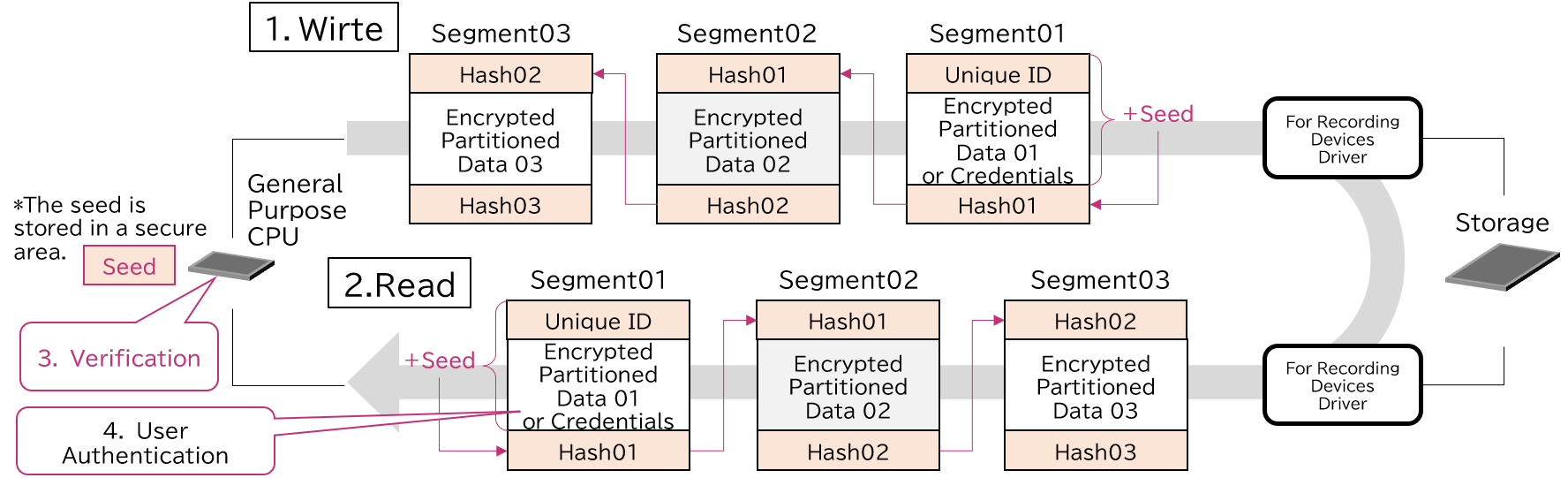
The Seed required for restoration is stored completely isolated in a secure area within terminal chips such as ARM TrustZone.
With this structure, even if chip-off analysis is performed to disassemble storage and extract raw data directly from memory chips, it is impossible to identify which is real data and in what order it should be combined.
Ultra-Fast Automatic Tampering Detection by "Hashchain"
To guarantee data integrity and authenticity, "Scramble Memory" adopts the data structure of our patented technology, "Hashchain".
When writing data, it performs encrypted splitting in segment units, combines the previous hash value with the data and Seed to generate new hash values sequentially, and records them in a chain.
The tampering verification process using the Hashchain structure achieves high throughput completing in less than 1ms, overcoming the conventional tradeoff where increasing security levels reduces system performance.
As a result, it does not cause practical bottlenecks even for real-time data writing in drones and cameras, or large-capacity data processing in NAS and similar systems.
When reading data, it instantly verifies each segment, and if even a single character of data has been illegally rewritten, missing, or improperly inserted, the system immediately detects the inconsistency produced by the chain of hashes and blocks data reading.
Data Protection on Transmission Paths and Chip-Level Security
The data protection capability of "Scramble Memory" is not limited to the state saved in storage, but achieves thorough security also in the process where data passes through circuits and networks.
(1) Measures Against Circuit Interception
Against bus sniffing attacks that intercept and analyze signals flowing through circuits and buses inside electronic equipment, it makes the legitimate integration order impossible to analyze by randomizing the order of recording and transmission and mixing in dummy data.
(2) Measures Against Man-in-the-Middle Attacks
When transferring and mirroring data to cloud storage or similar destinations, it blocks man-in-the-middle attacks through rearranging the recording order and mixing in dummy data.
(3) Device Authentication Using PUF Technology
Implementation of PUF technology utilizing physical individual differences of semiconductor chips is possible.
By linking encryption keys and Seeds to physical characteristics unique to chips, it achieves robust device authentication that is impossible to replicate or spoof.
Innovative Benefits Brought by the Ultimate Information Leakage Prevention Technology
"Scramble Memory" provides safety with zero risk of information leakage in every data operation scenario.
(1) Zero Risk of Information Carrying-Out or Theft
Even if portable devices such as smartphones, laptops, USB flash drives, or external storage are physically lost or stolen, data can never be restored or deciphered with the storage unit alone.
(2) Zero Risk of Physical Recording Device Removal
Even if circuit boards or storage media are physically removed or taken out from fixed storage such as PCs, servers, or NAS, the risk of information leakage is zero.
(3) Confidentiality Maintenance in Accidents or Device Loss
Even if devices such as drones or robots pass into the hands of third parties due to accidents or loss, internal data is completely protected.
(4) No Leakage Measures Needed During Disposal
When disposing of measuring and testing equipment, video/audio recording equipment, or information and communication equipment, there is no need to perform physical destruction of storage media or erasure measures using dedicated software.
By erasing the Seed stored separately in the secure area, it transitions to a 100% unrecoverable safe state in a process of less than one second regardless of data capacity.
Use Cases of "Scramble Memory"
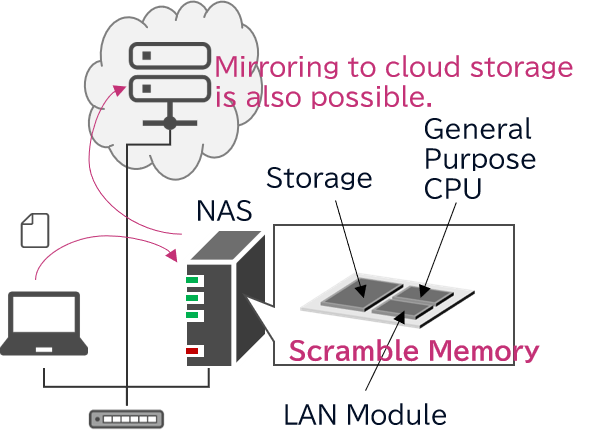
(1) External Recording Storage Such as NAS
In external data storage environments such as NAS where important corporate data is concentrated, "Scramble Memory" achieves an advanced storage environment that does not permit deciphering even against theft of the main unit or unauthorized removal.
It operates on general-purpose CPUs or dedicated chips inside NAS, executes encrypted splitting and Hashchain generation when storing data, and saves it in a distributed manner along with dummy data.
Because the Seed required for combining is completely isolated into a secure area, even if the NAS unit itself is carried out or a single drive is pulled out, data restoration outside is impossible.
Furthermore, when transferring to cloud storage as a backup, it mirrors by reordering data and mixing dummy data without leaving meta information, so consistent safety can be guaranteed also on transmission paths and on the cloud.
(2) Use Case in IoT, Physical AI, and Edge Devices
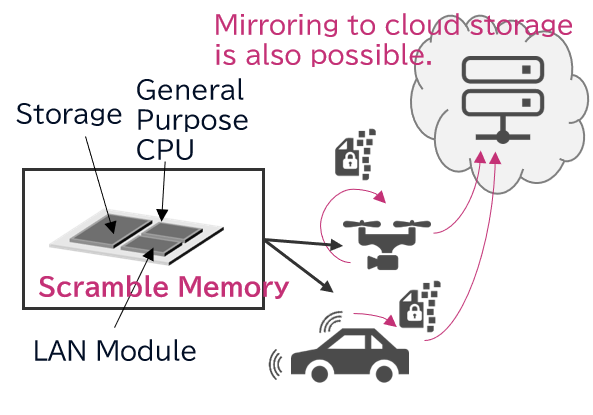
In the edge device field including drones, robots, and various sensor devices, it prevents data leakage accompanying physical loss or misplacement.
Through ultra-fast verification processing of less than 1ms, it follows without interfering with writing processing of sensor data generated in real time.
Even if drones or robots are leaked or recovered due to accidents or trouble on site, data inside the storage media is completely protected and will never leak to the outside.
In addition, in communication processes between edge devices and base units, performing verification combined with Seed information effectively blocks unauthorized access such as communication content tampering by third parties, unauthorized data insertion, and spoofing.
(3) Use Case in External Data Sharing and Disposal
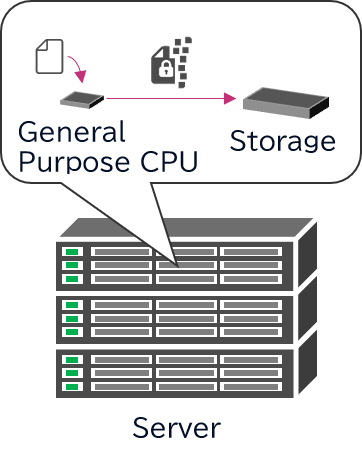
It is applicable to a wide range of business processes, from server environments requiring advanced confidentiality to safe data collaboration with external parties and equipment disposal.
Even if the inside of a server is intruded upon or storage is directly scanned, stored data is nothing more than a disordered array holding no meta information and cannot be deciphered without the isolated Seed.
When safely sharing data externally, passing through the "Scramble Memory" cloud platform and transferring after re-encrypting with the recipient's public key and converting into a Hashchain on the sending side provides a safe data sharing infrastructure replacing hand delivery or conventional file sharing.
Furthermore, when disposing of equipment, the process is completed simply by erasing the Seed stored in the secure area, transitioning to a completely unrecoverable state instantly regardless of data size, thereby significantly reducing operational costs such as physical destruction work or erasure work using dedicated software.
Worldview of "Scramble Memory"
Conventional data protection storage technology has developed on the premise of protecting boundaries of storage regions such as specific media or file units.
In contrast, "Scramble Memory" is a technology born from a thinking that transforms the dimension of security philosophy itself, embedding authenticity into data itself, protecting it structurally, and keeping it inviolable regardless of the operating environment.
Throughout the overall lifecycle from data generation to transmission, storage, and disposal, it consistently guarantees high security without impairing system performance.
Incapacitating all risks from physical device theft to OS intrusion, cloud collaboration, and equipment disposal, "Scramble Memory" is the one and only technology that embodies true zero-trust security.
Created in August 2026
HISAO ITO, CEO, Sees Co., Ltd.
Back to Top