
Autonomous Decentralized AI Cell & Hashchain Are the Core Technology of the Physical AI Era.
Sees Co., Ltd.
Sees Co., Ltd.
-
Back
Physical AI
Ahead of the rise of physical AI, we developed our proprietary "Autonomous distributed AI" technology.-
 Autonomous Distributed AI Cell
Proprietary technology chip realizing the ultimate Physical AI by operationalizing the Child AI concept and integrating it with Hashchain.Facial Recognition/Recognition AI Blockchain Surveillance Camera
Ultimate AI Blockchain surveillance camera integrating facial recognition AI into a Blockchain chip.AI Poisoning Prevention System
System completely preventing Data Poisoning vulnerabilities in AI equipped with an AI Front-End Engine.Data Security
We provide end-to-end data security from sensors to the cloud.-
Scramble Memory
Ultimate data recording method realizing the Zero Trust concept that remains unreadable even if stolen. -
Hashchain
Hashchain is the ultimate innovative technology in data security providing seamless end to end data protection from sensors to the cloud. -
Sees Blockchain
Blockchain optimized for industrial use realizing simultaneous operation of multiple applications through parallel processing. -
Sees Blockchain Security System
Security system linking blockchain products that satisfy four information security requirements of leakage prevention tampering prevention stable operation and user authentication. -
Blockchain Chip
Revolutionary technology in IoT control data security shrinking embedded blockchain into a single chip. -
Mobile Blockchain Nodes
Converts mobile devices into blockchain nodes and protects transmitted and received data through a blockchain network. -
Blockchain Transformers
Blockchain dongle that builds a blockchain node simply by connecting to a USB port. -
Blockchain Gateway
Builds a blockchain environment via LAN connection and protects transmitted and received data with robust security. -
Blockchain Server
Server preinstalled with industrial blockchain enabling immediate blockchain node setup upon installation.
DApps (Decentralized Applications)
DApps (decentralized applications) that utilize our proprietary "Continable NFT" technology.-
Consensus Lock
Shares consensus and conclusion among all meeting participants to prevent unnecessary trouble in advance. -
Beneficial Avatar
Clone trained on your own thinking and knowledge working on your behalf twenty four hours a day. -
NFT-based reservation rights issuance and trading system
Reservation right NFT issuance system realizing automated fair trade in bookings. -
Pre-packaged Blockchain
Builds and operates blockchain applications answering any needs for customization costs alone.
Development and Implementation Support
Whether it’s IT development or digital transformation (DX) implementation, feel free to consult us about anything related to IT.-
Sees Blockchain Development SDK
Software development kit with technical support that enables building blockchain applications without prior blockchain technology expertise. -
Blockchain custom-made development
Builds original blockchain within a low budget and short period while integrating with existing applications. -
Support for blockchain implementation
Total support service for blockchain digital transformation. -
Blockchain Learning Tool "Hakoniwa System"
World only blockchain learning tool for learning smart contracts while operating blockchain in a closed environment. -
 Sees Blockchain Linux
Linux optimized for blockchain to operate blockchain at high speed and with stability.
-


-
Back
Essence
A white paper-style story detailing Sees technology and history-
Autonomous Decentralized AI Cell Story
The core technology that logicized the concept of "Child AI" that autonomously learns, which is essential in the era of physical AI. -
Scramble Memory Story
The ultimate data security recording technology that achieves Zero Trust, born from the concept of protecting the data itself rather than the storage medium. -
Sees Hashchain Story
The origin story of Hashchain which represents the culmination of highly reliable technology in data transmission. -
Sees Blockchain Introduction
The story of blockchain from its dawn to the birth of Sees Blockchain. -
Sees Future Prospects
We will create the next generation of IT culture in the Physical AI and data security fields by bringing together technological capabilities cultivated in cutting edge infrastructure domains.
-


AI CELL
Pioneering Our Proprietary Technology "Autonomous Distributed AI" Ahead of the Physical AI Era
In fields like smart mobility and humanoids, the era of "Physical AI"—systems that act and make decisions autonomously based on sensor data—has begun.
Anticipating the peak of the Physical AI era, we have developed "Autonomous Distributed AI Cells" ahead of the competition.
Realizing the "Child AI" Concept and On-Chip Integration
The "Autonomous Distributed AI Cell" logicizes the very learning process of a newborn child through senses like vision and touch. We have successfully brought this "Child AI" concept to life and integrated it onto a silicon chip.
Achieving "Ultimate Physical AI" Through Collective Education
The "Autonomous Distributed AI Cell" features automatic integration of learnings from other cells, self-correction based on missing or conflicting information, and re-education capabilities for collective learning across multiple cells.
Here lies the Ultimate Physical AI: multiple "Autonomous Distributed AI Cells" learning independently, fostering mutual growth, and autonomously executing coordinated group behaviors.
Module
Autonomous Distributed AI Cell
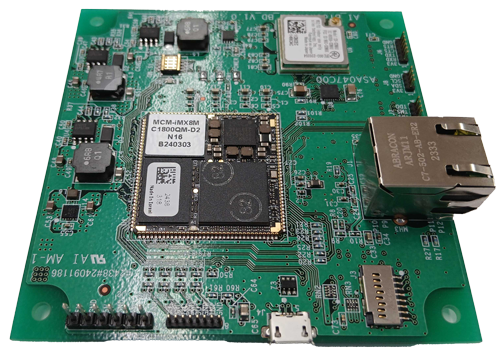
Evaluation Version
- Size: 85mm x 85mm
- Wired LAN / Wireless LAN Supported
- Power and sensor input signals accepted via pins
USE CASE
Autonomous Decentralized AI Cell
Use case
The "Autonomous Distributed AI Cell" is a world-first technology enabling fully unmanned factory operations and automated facility monitoring/management.
Requiring no individual pre-configuration for sensors or environments upon factory shipment, this composite chip behaves like an artificial neural cell—autonomously sensing its surroundings the moment it is installed and continuously learning various operational elements through active deployment.
Blockchain acts as the synaptic pathways of a neural network, guaranteeing data transmission integrity and enabling distributed processing.
In addition to artificial neural cell capabilities, it is built on highly distinctive, advanced logic that incorporates autonomous audiovisual sensory cells and autonomous nervous system functions akin to the cerebellum.
Use Case 1
Application in Factory Control
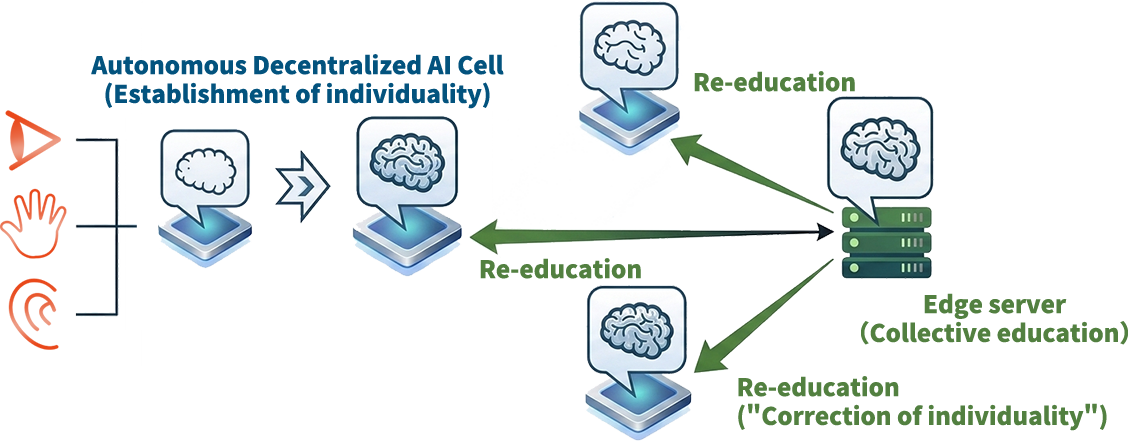
Equipment installed in a factory autonomously learns local operating conditions and behaviors through visual, tactile, and other sensory inputs, establishing its own "individual identity."
Even among identical machines, slight variations occur—such as subtle discrepancies in motor RPM—so each unit collects operational data to optimize itself for its specific site.
An edge server compares and analyzes data collected from individual units to execute "identity calibration," automatically adjusting voltage and other parameters so all machines deliver uniform output.
By sharing and adjusting (re-educating) the individual variations and experiences of each machine across the entire system, this approach prevents quality inconsistencies and builds a next-generation industrial infrastructure that continues to operate with high precision.
Use Case 2
Application in Autonomous Drone Control
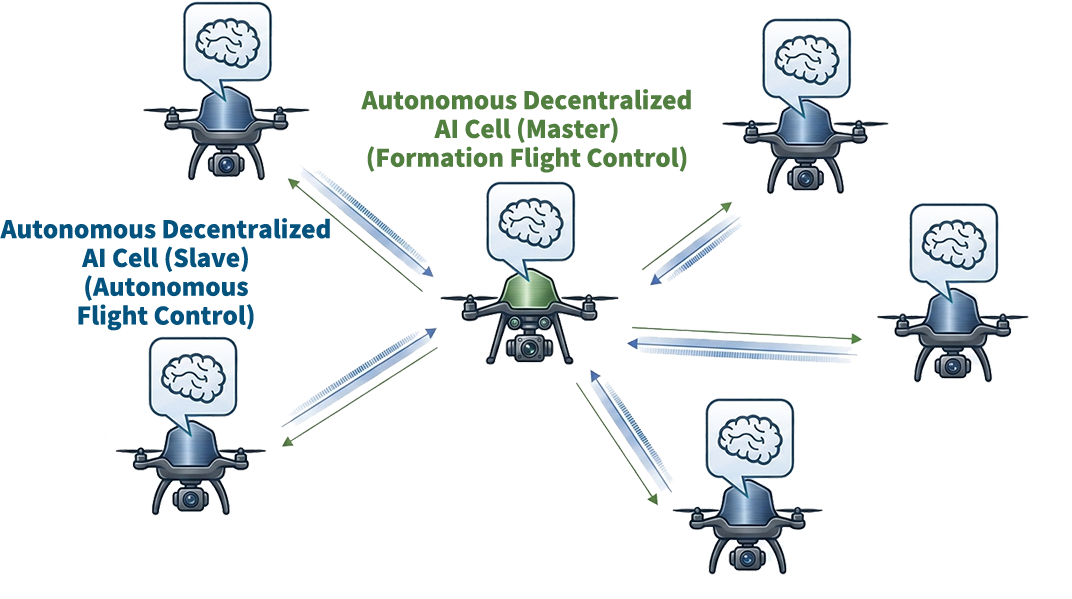
Based on collective action instructions from a master drone (Autonomous Distributed AI Cell [Master]), multiple slave drones (Autonomous Distributed AI Cell [Slave]) execute autonomously controlled flights while coordinating with one another.
Information such as obstacle avoidance and optimal routing learned by a single drone is shared across the entire fleet (collective education) via an edge server.
As the number of operating units increases, it unleashes a powerful collective network effect where the entire drone fleet automatically becomes smarter, enabling multiple AIs to drive mutual growth while executing autonomous group actions.
Use Case 3
Application in Predictive Maintenance
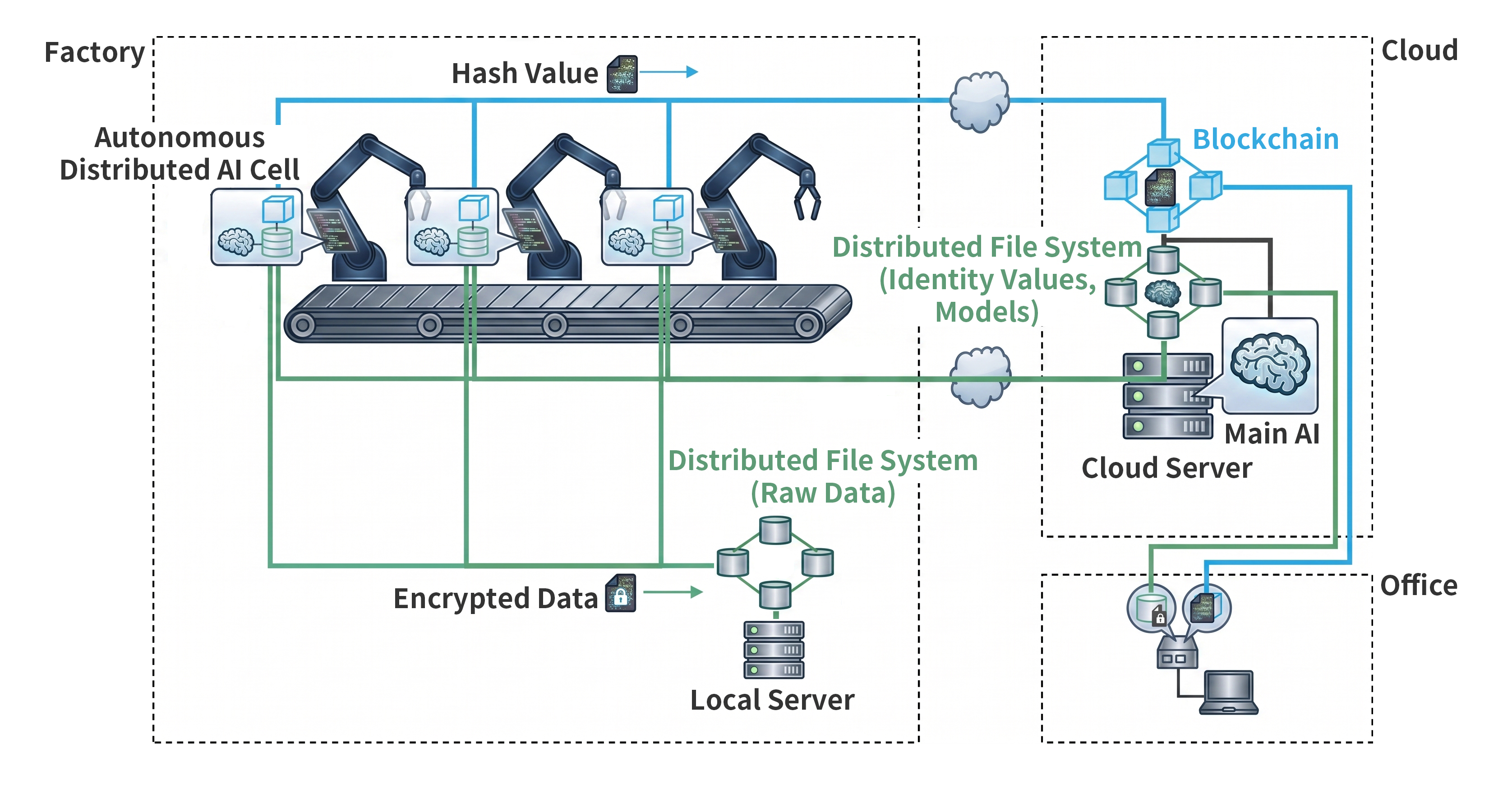
"Autonomous Distributed AI Cells" can be integrated into predictive maintenance systems for individual production lines or entire factories.
For example, anomaly detection models can be individually optimized based on the unique operational variations of each robotic arm, enabling significantly more accurate failure predictions.
LOGIC
Autonomous Decentralized AI Cell
Special Logic
Autonomous Distributed AI Cell incorporates special logic to make it autonomous.
- Individual Establishment Logic
- For example, some motors vibrate at 1000 rpm (revolutions per minute) and overheat abnormally, while others rotate normally even at 2000 rpm. The "Autonomous distributed AI cell" installed in each motor learns the individual characteristics of the motor it manages and sets a limiter to determine what is the normal line.
- Comparative learning logic for others
- "Autonomous distributed AI cell" share data with other "Autonomous distributed AI cell" to understand how the devices they manage are unique compared to other devices.
- Verbal Consciousness and Intention Logic
- "Autonomous Distributed AI Cell" simultaneously outputs human verbal information such as consciousness and intention, in addition to the usual sensor output digital data. For example, "It is a little hot" or "I feel a lot of vibration." This linguistic information can be directly connected to the existing linguistic input type AI to convey intentions and ask it to think and decide.
- Self-correcting logic
- Unlike ordinary monitoring systems, the "Autonomous Decentralized AI Cell" does not need to seek the judgment of the central monitoring system, but rather uses its own judgment to take action to output an alarm or extinguish a fire using localized sprinklers, etc., if the situation is dangerous enough to warrant urgent action.
- Ethical logic
- The off-premises higher-level servers and edge servers educate each "autonomous distributed AI cell" while making total predictions and judgments. (e.g., correction of output language information)
- Self-positioning logic
- By attaching GPS and altitude sensors to each "autonomous distributed AI cell," it is possible not only to notify the host server of the location where it is installed and the location/device where an abnormality is detected on a 3D map, but also to identify and grasp the location by itself.
- Re-education Logic
- Periodically poll the "Autonomous Distributed AI Cell" to create a 3D map based on normal operation availability, location movement, status, etc., and constantly update the version. This allows the system to autonomously update its latest position and role without the need for human configuration.

While AI for manufacturing equipment requires identical movements and precision, autonomous humanoids such as collaborative robots demand a wide variety of motions.
It is ideal for integrated control and maintenance that understands the unique characteristics of each unit.

Back to Top